TL;DR
- Beauty coworking spaces are turnkey shared workspaces for stylists and estheticians offering flexible chair and room rentals in a community setting.
- The model lowers startup costs, improves revenue potential versus traditional salons, and is growing with beauty entrepreneurship.
- Automating bookings, payments, and access control saves significant manual time and helps operators scale efficiently.
Last updated: October 22, 2025
The global salon service market was valued at $215.65 billion in 2022, with an expected compound annual growth rate (CAGR) of nearly 8% through 2030.
This means there’s no better time to start a salon service business than in the next six years.
But as the market grows, so does the opportunity for innovation. One such innovative approach to the traditional salon model is beauty coworking spaces.
Part salon, part coworking space, they are the ideal way for budding beauty entrepreneurs to start their own business – and they just may be the future of the industry.
Here at Optix, we serve a number of beauty coworking spaces without software including Fizzy Collective, Kay Taylor Salon Suites, and LOOK Style Society. In this article, we’ll share everything we’ve learned about this exciting new area of coworking from the experts themselves – our clients.
- What is a beauty coworking space?
- Key features of beauty coworking spaces
- Who uses beauty coworking spaces?
- What was the first beauty coworking space?
- Why are beauty coworking spaces becoming more popular?
- What is the difference between beauty coworking spaces and salons with booth rentals?
- How do beauty coworking spaces make money?
- How do beauty coworking spaces benefit beauty professionals?
- What are some examples of beauty coworking spaces?
- What technology do you need to run a beauty coworking space?
- How does automation benefit a beauty coworking space?
- How to successfully open a beauty coworking space
What is a beauty coworking space?
A beauty coworking space is a shared workspace designed specifically for hair stylists, makeup artists, nail technicians, and other beauty professionals.
Beauty coworking spaces are typically turn-key, meaning they are equipped with all of the services and amenities one might need to run their own business. They are also able to be customized to the individual.
With this model, any beauty professional could walk off the street and rent space in a beauty coworking space on a daily, hourly, or monthly basis.
Key features of beauty coworking spaces
While each beauty coworking space is unique, there are some key features that are found across most locations.
- Shared equipment like chairs and wash basins: shared salons are turnkey and come with a variety of shared equipment available to rent
- Flexible rental options on-demand: beauty coworking spaces offer flexible rental options and usually same-day booking availability
- A mix of spaces for different services: while some shared beauty spaces are for a specific type of service, most cater to a variety of different professionals
- Unique amenities like mentoring opportunities and networking events: along with space and equipment, beauty coworking spaces also offer events, mentorship, and a sense of community amongst otherwise isolated members
Who uses beauty coworking spaces?
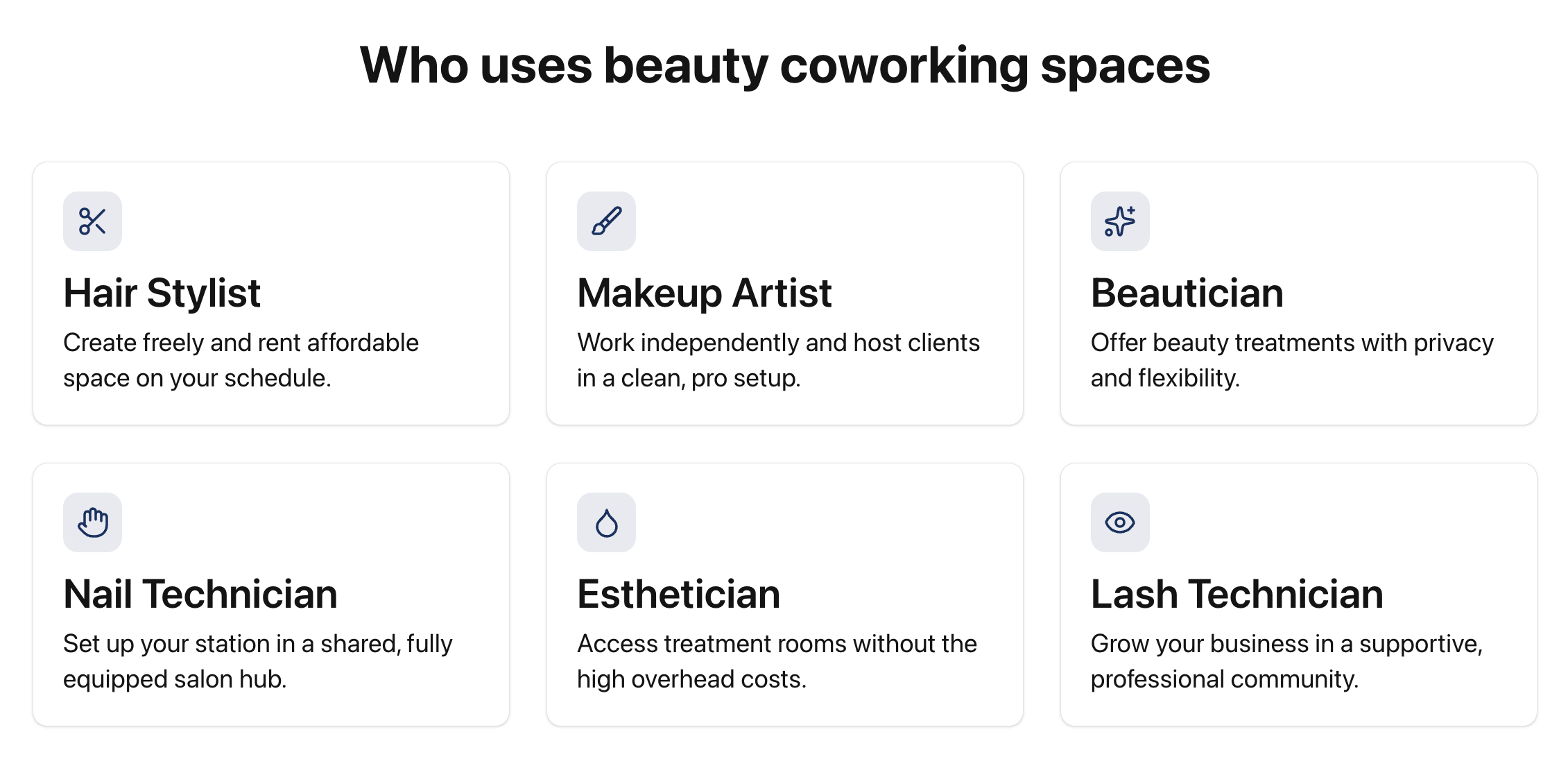
Beauty coworking spaces are best suited for salon and beauty professionals who want a low-cost way to work for themselves. This includes:
- Hair stylists
- Makeup artists
- Beauticians
- Nail technicians
- Aestheticians
- Lash technicians
While some shared beauty spaces will target one or two specific crafts, most are equipped to handle a variety of different service providers. This is part of the magic of a beauty coworking space compared to a traditional salon.
What was the first beauty coworking space?
Though beauty coworking spaces are gaining traction now, many are surprised to learn that the concept is not new.
The first reported beauty coworking space, IMAGE Studios, opened in Utah in 2009. After seeing how the industry limited the growth of beauty professionals, Founder Jason Olsen created a space where salon professionals could access the equipment and space they needed to find success independently.
He designed a physical space that resembled a collection of private offices in a coworking space. But instead of desks and chairs, each private room housed a unique salon set-up customized to the individual — whether they needed a space to cut hair or thread brows.
Today, there are over 30 IMAGE Studios locations across the US offering clean, modern, and professional work environments for beauty professionals, as well as hundreds of independent beauty coworking spaces all over the world.
Get your free Beauty Coworking eBook
Why are beauty coworking spaces becoming more popular?
Beauty coworking spaces are becoming more popular due to the rise of beauty entrepreneurship resulting in more favorable revenue sharing models.
The rise of beauty entrepreneurship
We’ve talked a lot about how entrepreneurship is shaping the coworking and flex space industry, and beauty coworking spaces are no exception.
Lash technicians, hair stylists, makeup artists — they all want the freedom and space to practice their craft independently.
Rather than invest the time, money, and effort it would take to open their own salon, they can work out of a shared workspace and get many of the same benefits as owning their own business, but at a fraction of the cost. They also benefit from better revenue sharing models as a result.
What is the difference between beauty coworking spaces and salons with booth rentals?
Traditionally, salons and other spaces for beauticians operate under one of two models:
- Commission based: the owner of the salon takes a cut of every service done by the stylist (ie. 50% of a $100 hair cut)
- Booth rental or chair rental: the stylist pays daily, weekly, or monthly rent to the salon owner (ie. $150 a week)
In both of these models, the owner of the salon is typically responsible for providing all materials (with some exceptions) and managing the space including cleaning, back-end operations, and hiring.
Beauty coworking spaces are similar to the booth rental model in that members pay a flat fee in order to use the space. Some equipment is provided to them, too.
The main difference is that beauty coworking spaces serve a variety of beauty professionals (vs. a traditional salon that may just serve hair stylists or lash technicians), are focused on community building, and truly offer a flexible approach to working.
| Traditional salon | Beauty coworking space |
| Offer one service (ie. skin, hair, or nails) | Offer services from a variety of professionals |
| Are transactional in nature | Are centered on building a community |
| Offer less flexibility with booth rentals | Have very flexible membership offerings |
How do beauty coworking spaces make money?
Beauty coworking spaces make money by selling space in the form of chair, room, and equipment rentals.
Let’s say that Lauren opens a beauty coworking space, and it costs her $10,000 a month to rent the space. She offers four private rooms to rent at $600 a month, two private rooms to rent daily at $100 a day, along with daily rentals of eight chairs starting at $50 a day.
If she reaches 75% occupancy of her space, she’ll generate $15,300 a month in total or $5,300 in profit per month.
In this sense, the business model is the same as the coworking business model.
How do beauty coworking spaces benefit beauty professionals?
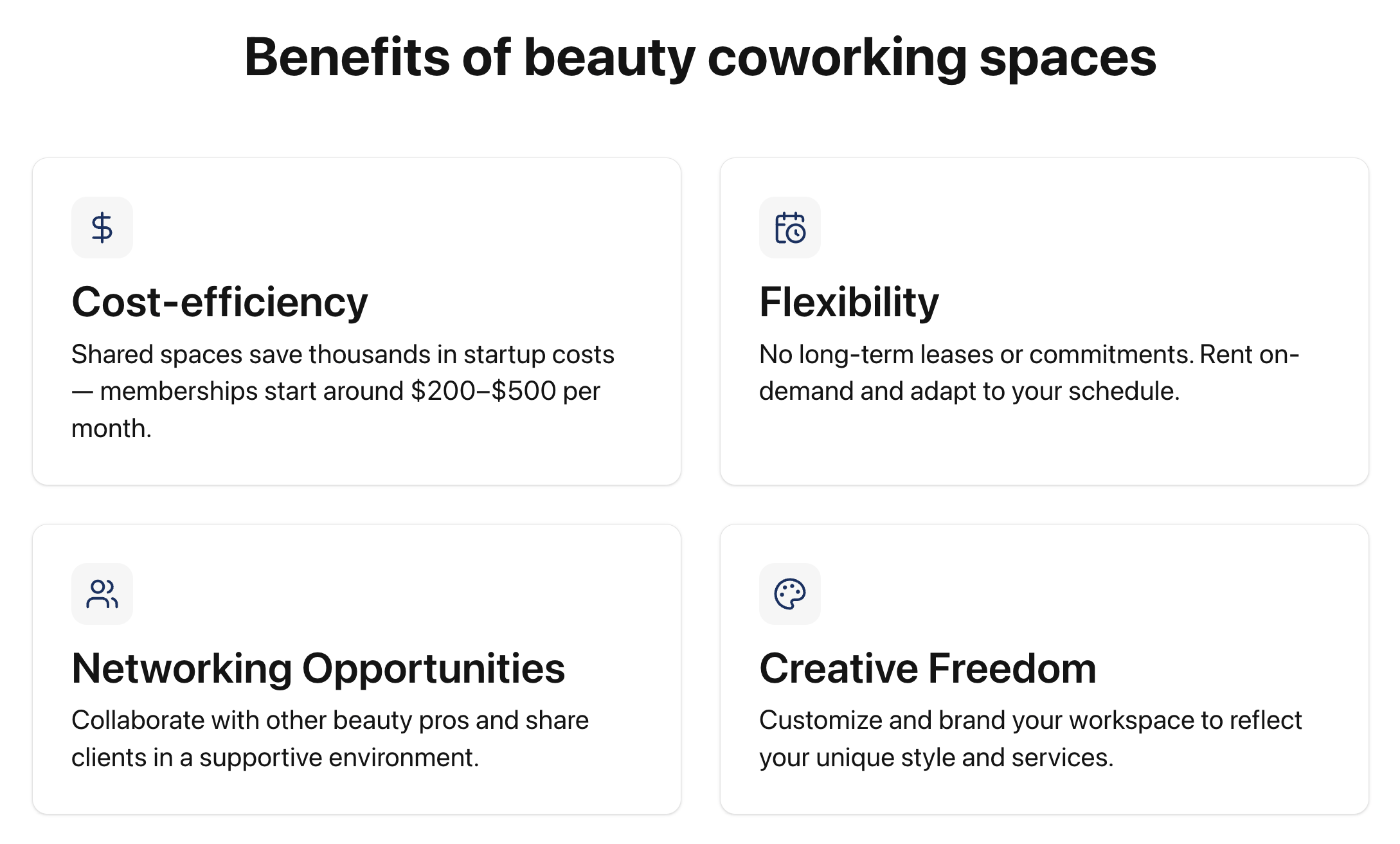
As with many niche coworking spaces, the greatest benefits of shared spaces for beauty professionals are cost-efficiency, flexibility, networking opportunities, and creative freedom.
Cost-efficiency
If you wanted to open a salon, it could cost you up to $200,000. That is a lot of money for a young, aspiring makeup artist to shell out.=
In contrast, joining a shared beauty workspace costs a small monthly fee of anywhere between $200 and $500. They are also turn-key so all you need to worry about is showing up and doing a great job, not managing P&Ls and cleaning schedules.
Flexibility
With a traditional salon, members can sometimes be locked in to long-term leases or long-term employment agreements with the manager of the salon.
In beauty coworking spaces however, members aren’t usually locked in to long-term agreements and can rent space on-demand, providing greater flexibility to fit their changing schedules.
View this post on Instagram
A post shared by BEAUTY COWORKING SPACE TORONTO (@beauty.community.toronto)
Networking Opportunities
Not only are you working alongside other talented professionals in a beauty coworking space, you’re working alongside referral opportunities and potential clients.
If you’re a hair stylist, there’s a lot to gain from working in the same building as a makeup artist and a lash technician, where you can share client info and utilize each other’s services.
Creative Freedom
When you rent a chair in another salon, you don’t have a lot of room to personalize or brand your space. Working in a beauty coworking space can give you more creative freedom because you get to “own” the space you have, especially if you’re working in a long-term capacity.
For those renting their own room on a monthly basis, this can be huge.
Fizzy Collective, a UK-based beauty coworking space shared a few more benefits of working in their coworking space in a recent Instagram post including:
- Ability to set your own schedule
- Able to use and choose your own products
- No external sales targets
- Needing to be in the space, even if you don’t have a client
What are some examples of beauty coworking spaces?
Looking to be inspired? Let’s take a look at these four Optix clients who are shaping what it means to be a modern, service-oriented coworking space for beauty professionals.
Fizzy Collective
Year established: 2024
Located in: Bristol, England
Locations: 1
Fizzy Collective is a beauty coworking space in the UK serving hair stylists, beauticians, makeup artists and many more in the beauty industry.
Started by two sisters, the community is all about inclusivity and sustainability, with a commitment to providing a creative and flexible space to work out of. The space itself is beautiful, colorful, and equipped with everything someone would need to find success.
Kay Taylor Salon Suites
Year established: 2022
Located in: Modesto, California
Locations: 1
Kay Taylor Salon Suites is a shared space for beauty professionals in Modesto, California. They offer state-of-the-art facilities to empower beauty entrepreneurs in a modern and luxurious space.
At Kay Taylor Salon Suites, members keep 100% of their profits, enjoy private secure spaces personalized just to them, and can set their own prices for their services, making it a complete member-oriented workspace.
LOOK Style Society
Year established: 2013
Located in: Las Vegas, Nevada
Locations: 2
LOOK Style Society is a beauty professional workspace in Las Vegas, Nevada. They offer an extensive menu of services from waxing to men’s haircuts to body treatments and so much more.
Members can enjoy a sense of community, top notch amenities, and access to a wide variety of specialty equipment and materials to perfect their craft.
Gallery Salon Studios
Year established: 2020
Located in: Netherlands
Locations: 4
Gallery Salon Studios provides 24/7, move-in-ready studio spaces for hair and beauty specialists in the Netherlands.
They offer both full memberships, where members get full access to their own private salon space (much like a private office membership), as well as flex memberships for those looking for a more flexible, on-demand option.
What technology do you need to run a beauty coworking space?

Technology is your best friend when it comes to running a shared space for beauty professionals. At a minimum, you’ll want:
- Booking software: easily book rooms and chairs
- Payment gateway: automate payment collection and processing
- Access control system: automates access to the space
These three systems together will help you create a technology ecosystem that can help you run your beauty space.
How does automation benefit a beauty coworking space?
Implementing automation in your shared beauty space can help you spend up to 50% less time on manual tasks. This extends across the entire member journey including nurturing leads, onboarding new members, upselling, and engagement.
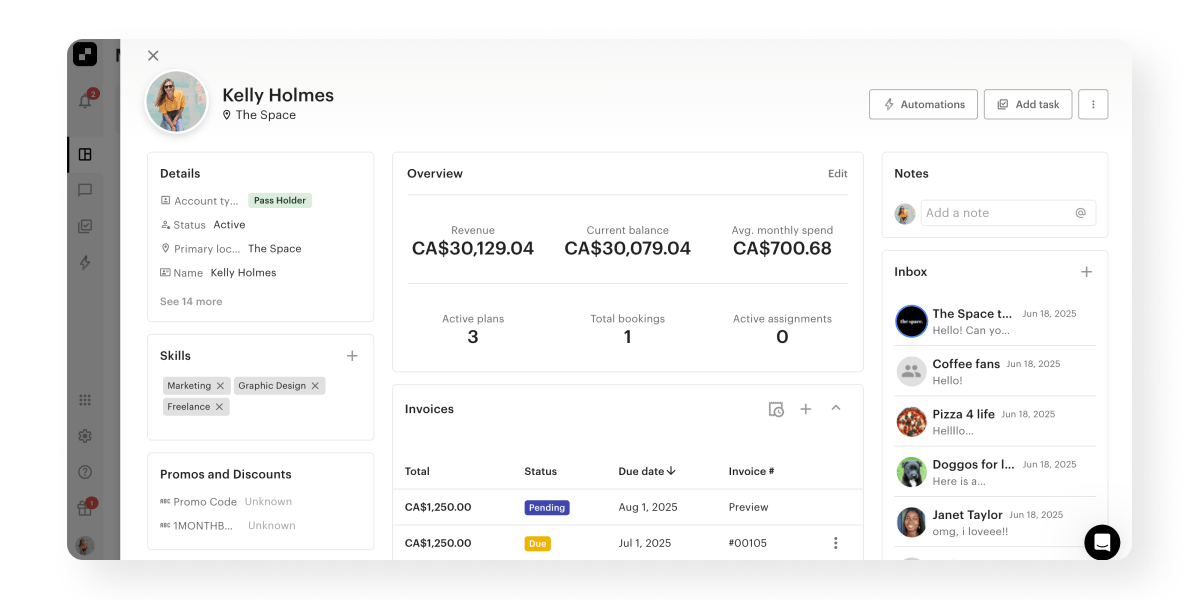
Optix is a flex space management software that helps shared workspaces including coworking spaces, golf simulators, and shared salons automate their most redundant manual tasks.
With Optix, shared salons can:
- Automate their entire operations, from lead nurturing to invoice follow-ups
- Engage their community with 1:1 direct messaging
- Grow their business with features built to scale
Automation is really the only way to get ahead and sustain a profitable business in 2025.
Run your beauty coworking space with Optix
How to successfully open a beauty coworking space
At Optix, we’re all about enabling coworking and flex space leaders to thrive (it’s our mission, after all).
We’ve worked with hundreds of coworking and flex space operators, including beauty coworking spaces, to give them the tools they need to find success in an ever-evolving industry. Here are a few tips for opening a beauty coworking space, based on learnings from our clients over the last few years.
1. Location is everything
Location is everything in the world of coworking. In fact, 37% of workers say the greatest benefit of a coworking space is the convenient location.
When opening a niche or targeted coworking space, location becomes especially important because you need a large enough number of potential clients located near you.
Market research will show you if there is a large enough market to support a beauty coworking space in the area you want. It’s not enough to assume that a metropolitan city can support the concept and a rural location can not. Niche coworking spaces all depend on the concentration of certain people in the area, which could be higher in one location compared to another.
2. Lean into the intangibles
It’s easy to conceptualize having the most beautiful space, fantastic equipment and lovely artwork all over your walls.
But what people really want from a coworking space are the intangibles. The most successful operators are those who invest in community building, networking events, and mentorship opportunities — the things people can’t get anywhere else.
This is what will ultimately get people to commit to your community, more so than anything else you offer.
3. Choose the right technology
An important but often overlooked part of opening a beauty coworking space is choosing the right technology to operate the backend. This part can make or break your business, and choosing technology that is reliable, works well, and that you enjoy using is crucial to success.
At Optix coworking software, we provide coworking and flex space operators, including beauty coworking spaces, the technology they need to automate their operations, engage their community, and grow their business. Automation is the key to doing more with less and running a business, especially as a small team.
The future of coworking spaces for beauty professionals
Our prediction is, like most niche coworking trends, beauty coworking spaces are only going to grow in popularity over the next 2-5 years. As more beauty entrepreneurs look for creative ways to run their business, beauty coworking spaces will take center stage as a solution to the challenges of a traditional salon model.
Within the niche itself, we predict a greater emphasis on community building to more closely resemble a coworking space with events, networking opportunities, and more.
Are you looking to open a beauty coworking space and want to understand how technology fits into your business? Connect with a member of our team today.
Marketing Manager
Kelly Karn is the Marketing Manager at Optix coworking software. She's been covering the latest and greatest in the world of coworking for 4 years and is one of the leading voices in coworking content having written over 300 articles. You can find her work on Coworking Insights, Coworking Resources, Allwork.space, DeskMag, GCUC, and (of course) the Optix blog.
Frequently asked questions
Use a mixed model: monthly private rooms for anchor revenue, day-rate rooms for trial, and hourly chair rentals to maximize utilization at peaks. If you’re asking “how should I structure memberships and pricing,” layer dynamic pricing for weekends/evenings and bundle consumables or laundry as add-ons. Your draft already shows room, day, and chair revenue working together; extend that with peak pricing and late-cancel fees.
Operators usually carry general liability, property, and professional liability (as landlord/operator), while each stylist in a flex or coworking space should carry their own professional liability and product liability coverage. If you’re wondering “what insurance should a beauty coworking operator carry,” make proof of member insurance a condition of access and verify at onboarding.
Partner with cosmetology schools, bridal planners, and local hotels, and host certification classes or pop-up events during off-peak hours. When you ask “what are smart ways to grow demand,” remember your draft’s point that location convenience is a top coworking driver; align outreach within that radius and use community events to differentiate.
Track utilization by asset (chairs, rooms), member retention and churn, average revenue per rentable unit, peak vs. off-peak fill, add-on sales (laundry, storage), and time saved via automation. If you’re asking “which KPIs matter most,” tie targets to the sample P&L structure in your guide and use automation to surface trends without adding headcount.