TL;DR
- Customer-first design and seamless booking systems built Le Birdie’s foundation for success
- Smart automation drives personal connections and year-round engagement despite seasonality
- Inclusive programming creates a diverse, loyal community that fuels sustainable growth
As they prepared to move back to Montreal from Toronto, Le Birdie co-founders Jessie and Harry found themselves asking a simple question that would change everything: “Where are we going to go and play golf?”
Living in Canada, they’d developed a love of indoor golf during harsh winters. But when they started researching Montreal’s golf simulator scene, they were disappointed by what they found. The technology wasn’t cutting-edge, the customer experience felt clunky, and Quebec seemed to lag behind other markets when it came to integrated, seamless experiences.
So instead of just finding a place to play golf, they decided to create the facility they wished existed. What followed was six months of rapid growth that proved their instincts right.
Today, Le Birdie has built a thriving community around their inclusive vision of golf. They key to their success? Understanding that great businesses are built on great customer experiences. Here are the key lessons they’ve learned about turning an entrepreneurial vision into sustainable success.
Learn how Le Birdie runs their 24/7 indoor golf simulator with Optix Automations

1. Start as a customer first
The most valuable market research Jessie and Harry conducted was their own frustrating experiences trying to find a decent place to play golf indoors.
This customer-first approach gave them insights no competitor analysis could provide. They experienced firsthand the clunky booking systems, the outdated technology, and the disconnect between what passionate golfers actually wanted and what existing facilities were offering.
When they couldn’t find what they were looking for in Montreal, they didn’t just assume the market didn’t want it – they knew from personal experience that it absolutely did.
The lesson? Don’t start with what you think the market needs. Start with what you, as a genuine customer, actually need. Jessie and Harry’s deep understanding of the golfer’s journey – from booking frustrations to technology disappointments – became the foundation for every decision they made at Le Birdie.
“We tried a few different places and then we learned what was important to us as customers. And we found out that the most important technology was not all over the place, especially in the center of Montreal.”Jessie Ouimette Caron, Co-founder at Le Birdie
2. Design the entire customer journey, not just the golf
While many golf simulator businesses focus on having the best technology or the nicest facility, Jessie understood that the magic happens in the spaces between – the booking process, the payment experience, the door access, even how customers report issues.
Her vision was ambitious: customers should be able to book in just three clicks and seamlessly move from decision to play without any friction points. This meant thinking through every possible touchpoint:
- How intuitive is the booking process?
- Does payment feel secure and simple?
- Can customers easily access the facility using their phone?
- What happens when they need help or want to report an issue?
- How do they purchase add-ons like merchandise?
The stakes were even higher for Le Birdie because of their 24/7 automated model. Unlike traditional facilities with staff to guide customers through problems, every step had to work flawlessly on its own using software just for golf simulators.
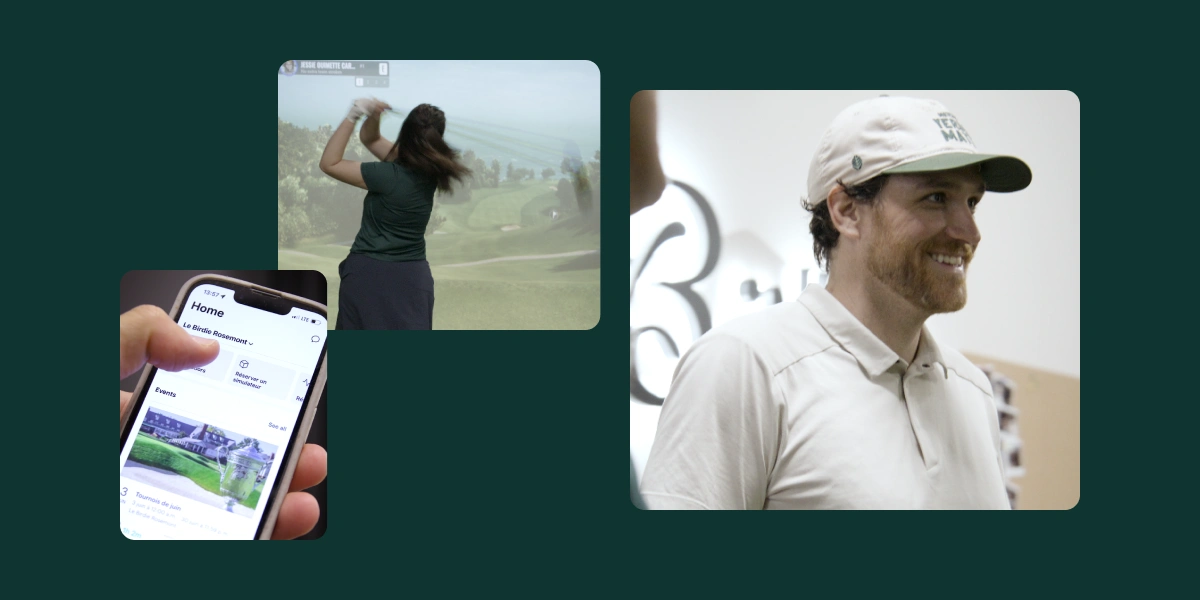
Jessie’s attention to the full journey paid off dramatically. With over 90% app adoption and customers averaging 3 bookings each, it’s clear that the seamless experience keeps people coming back.
“It was really important that the customer journey was as smooth as possible, so that people can just go through the steps. And because it's 24-hour, all online, and all self-serve, it needs to be as easy as possible.”Jessie Ouimette Caron, Co-founder at Le Birdie
3. Embrace being fully automated (while still staying human)
One of the biggest challenges Jessie and Harry faced was how to create genuine personal connections in a business where customers might never actually meet them in person. Their solution? Use automation to enhance human connection, not replace it.
The key insight was recognizing that automation could actually make interactions more personal, not less. Instead of generic corporate messaging, Jessie created personalized milestone-based campaigns that celebrated achievements.
She also chose in-app chat over traditional email for customer communication, understanding that the medium matters as much as the message. The results speak for themselves: Le Birdie has sent over 12,000 messages through their platform, creating touch points that feel personal and immediate.
Automation doesn’t have to feel robotic. When designed thoughtfully with human psychology in mind, automated systems can create more meaningful connections than traditional manual processes ever could. Learn how Le Birdie runs their 24/7 indoor golf simulator with Optix Automations
“In automations and through chat, we always put our personal names, Jessie and Harry at Le Birdie. People really feel connected to us as people, even if they mostly will never see us.”Jessie Ouimette Caron, Co-founder at Le Birdie
4. Plan for seasonality from day one
Most golf simulator businesses learn about seasonality the hard way – when summer hits and their revenue drops while their fixed costs remain the same. Jessie anticipated this challenge and built a strategy to turn seasonal downturns into opportunities for deeper engagement.
Jessie’s solution was multifaceted. During slow periods, she uses automations to run engagement campaigns, like giving free hours to loyal customers and encouraging reviews.
Learn how to maximize profits in your golf simulator
Instead of watching customers disappear and return as strangers months later, Jessie maintains relationships year-round using Optix. When golf season returns, those community members convert back to active users with much higher retention rates.
The broader lesson for seasonal businesses is clear: plan for your slow periods as strategically as you plan for your busy ones. The relationships you nurture during downtime often determine your success when demand returns.
“I thought, if this is going to happen with seasonality, that's when I'm going to use this strategy to reengage. With the app, I can message them and then it pops up on their phone. Yes, it's summer, but if they see we're doing a tournament, maybe they’ll pop in.”Jessie Ouimette Caron, Co-founder at Le Birdie
5. Design for inclusivity, not just profitability
While many golf businesses chase high-end customers and premium pricing, Jessie and Harry made a deliberate choice to challenge golf’s exclusive reputation. Their “golf for everyone” messaging became a strategic differentiator that built a stronger, more sustainable community.
The inclusivity approach extends across the entire business from pricing to programming to culture. Jessie actively creates mixed-gender events and tournaments, ensuring that Le Birdie welcomes “all genders and skill levels.” This stands in stark contrast to many golf facilities that cater primarily to experienced male players.
The results prove that inclusivity and profitability aren’t mutually exclusive. Le Birdie’s diverse customer base creates a more resilient business model – they’re not dependent on a single demographic or customer type. Their community-focused approach has generated genuine word-of-mouth marketing and higher retention rates.
“We created Le Birdie to make great indoor golf more accessible and more flexible. We just want to create a place where everyone can feel they can learn or play their sport without being judged.”Jessie Ouimette Caron, Co-founder at Le Birdie
Building something bigger than golf
Six months after opening Le Birdie’s doors, Jessie and Harry have proven that entrepreneurial success is really about understanding people. Their journey from frustrated customers to thriving business owners offers a blueprint for anyone looking to build something meaningful in their industry.
Over 1,500 users, nearly 4,000 bookings, and 90%+ app adoption didn’t happen by accident. They happened because Jessie and Harry understood that technology should enhance human connection, not replace it. They happened because they designed every touchpoint with their customers’ actual needs in mind.
Perhaps most importantly, Jessie and Harry have shown that staying true to your values doesn’t mean sacrificing business success. By building a business that reflects their belief in accessibility, community, and genuine service, they’ve created something that competitors will struggle to replicate.