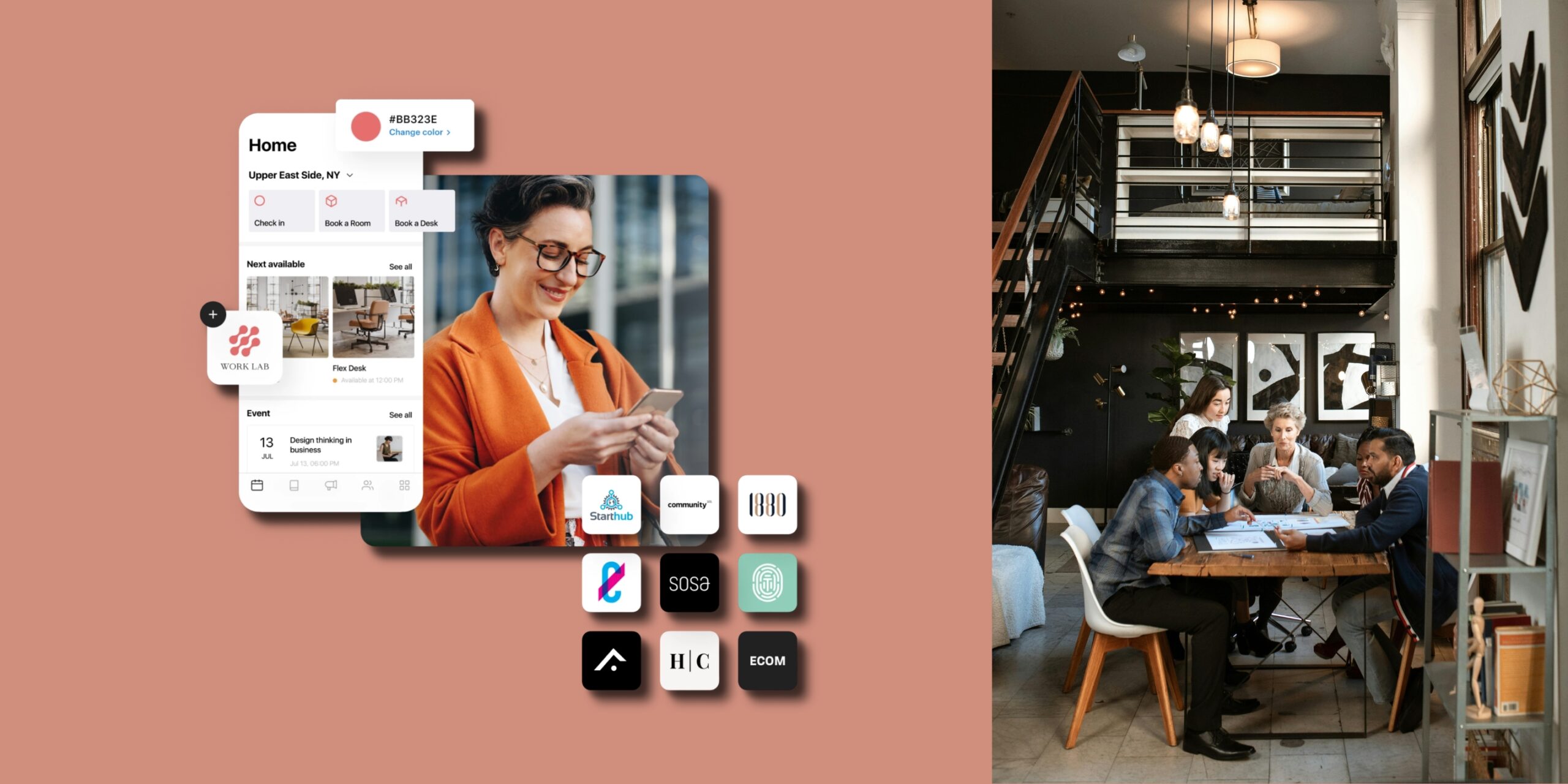
Hot desks and events build the community in a coworking space; private offices rent access to it. The flexible layer is where new members first show up, and a regular events calendar is what turns those new faces into a network that recognizes each other. Private offices deliver longer terms and higher revenue per seat, but the community that keeps those tenants renewing is generated by the hot-desk and events layer around them.
What actually builds community in a coworking space?
Community in a coworking space is built through repeated, low-commitment contact between people who would not otherwise meet. It forms at the hot desk and the events calendar, not in a private office behind a closed door. A long lease buys square footage. Belonging gets built in the shared space around it.
Most operators already know community is the work, and most want more time for it. In a recent Coworking Automation Survey, 63% of coworking operators said they wish they had more time to build community, ahead of every other priority on the list.
The wider workplace has spent five years relearning the same lesson. Harvard Business Review’s research on hybrid work found that distributed arrangements weaken collaboration, deepen isolation, and erode culture. The one thing an office still does better than a laptop at home is put people in a room together. For a coworking space, that room is the product.
Why do private offices look like the smarter play on the spreadsheet?
Private offices win on every line of the spreadsheet. They carry longer commitments, higher revenue per seat, and lower churn than flexible plans, so the model rewards filling a building with them. Operators have spent years optimising for that math, and the events calendar is usually the first line cut to protect it.
The commitments are getting longer, which makes private space look even safer. CBRE data reported by Coworking Europe shows average flex lease durations in London reached a record 22 months in mid-2025, with completed deals up 25% year over year.
The logic is sound on a spreadsheet and incomplete inside a building. A private office is revenue you can forecast. It is not, on its own, a reason for anyone to walk through the door in the first place.
What do hot desks actually do for a coworking space?
The hot desk is the front door of a coworking space. It is the lowest-commitment way in, which makes it where new members first appear: the freelancer trying the space for a day, the founder between offices, the drop-in who slowly becomes a regular. Private offices rarely produce that first visit. The flexible layer does.
The real-estate industry has started to price this in. In NAIOP’s 2025 office market analysis, iQ Offices CEO Kane Willmott describes flexible spaces as “creating holistic experiences that drive engagement, productivity and meaningful ROI on workspace investments,” not as rows of desks to be filled.
That is the real job of the hot desk. It seeds the network. Every new face at a day pass is a potential regular, a potential referral, and a potential office tenant two years from now.
Why do events turn hot-deskers into a community?
Events convert a familiar face into a name the room recognizes. A hot desk puts someone in the building; an event gives them a reason to talk to the person two desks over. That is where the introduction happens, where the “I had no idea you did that” conversation starts, and where a referral six months later quietly begins.
Events also pay their own way. Operators are increasingly programming their event and meeting spaces as a public revenue stream, as Facilities Dive reported in late 2025. Playbook CEO Colleen Werner describes operators hosting weddings and showers in amenity spaces on weekends to offset the quieter days.
So the events calendar is both the community engine and a line of revenue. That is exactly why cutting it to tidy up the P&L is a false economy: you remove the thing that fills the building and the thing that earns on the side.
How does the hot-desk and events layer protect private-office revenue?
The flexible layer protects private-office revenue by raising the lifetime value of every other plan. A private-office tenant renews because the building feels alive, because they have met people in it, because leaving would mean leaving a network. Strip out the hot desks and events, and the office becomes a room that any landlord could rent.
The operators with the strongest flexible layers tend to hold their long-term tenants the longest. Workspace MA, a five-location Boston network running on Optix, the coworking management platform, reports a 26-month average member tenure, with some original members still active after ten years. The energy in the shared space is what makes those offices worth keeping.
Looked at this way, hot desks and events are not a low-margin distraction from the real revenue. They are the operating cost of the renewals that make the real revenue dependable.
How can operators run a flexible hot-desk layer without drowning in admin?
A flexible layer only works if it does not bury the team in admin. Day passes, pre-paid bundles, drop-in credits, and mixed-use plans create far more billing events, sign-ups, and access changes than a handful of annual office leases. Without automation, the front desk drowns, and operators quietly retreat to the simpler private-office model.
This is where the software earns its place. With flexible membership plans in Optix, operators can build pre-paid bundles, day passes, and mixed-use credits that bill, renew, and grant access automatically. The same automation handles the moment a hot-desker joins, so the welcome message, the access grant, and the first booking happen without anyone keying them in.
The point is not the software for its own sake. It is that automation is what makes a community-first plan mix survivable at scale. The team gets the hours back to do the part a tool cannot: run the event, make the introduction, learn the regular’s name.
How should operators treat hot desks and events on the P&L?

Treat hot desks and events as a community function, not as leftover inventory. Their value rarely shows up on their own line of the P&L. It shows up in private-office tenure, in the referral pipeline, and in the occupancy that holds through a downturn. Judge them on what they protect, not only on what they bill.
Bad Company, the community-driven coworking space co-founded by Tori Taylor in Mount Maunganui, New Zealand, is a clear example. The team shifted from a mostly permanent-member base to a flexible mix of drop-ins and hot-desk users, a move that nearly doubled their first location’s capacity and now runs across more than 1,000 active membership plans and 12,000+ bookings. You can read how Bad Company runs a flexible drop-in and hot-desk mix in their full story.
"Connection never goes out of fashion. It's never going to be a fad. People have always craved connection to congregate and converse."Tori Taylor, Bad Company
How to treat hot desks and events as a community function:
- Keep a visible hot-desk and drop-in option, not only offices.
- Run a regular events calendar, not occasional one-off socials.
- Automate plans, billing, and bookings so staff avoid manual admin.
- Measure event attendance and repeat visits, not just occupancy.
- Track private-office tenure as a community outcome.
- Reinvest the saved hours into hosting and member introductions.
The operators who win the next five years won’t be the ones who squeezed the most offices into the floor plan. They’ll be the ones who kept the room alive. If you want to run a flexible, community-first plan mix without adding admin, you can book a free demo and see how Optix handles it.
Key Takeaways:
- Hot desks and events build coworking community; private offices rent access to it.
- The flexible layer is where new members arrive and become regulars.
- Community drives the retention that keeps private-office tenants renewing.
- Cutting events to protect the P&L removes the engine that protects it.
- Automation makes a community-first plan mix survivable without more admin.
- Judge hot desks and events on what they protect, not only what they bill.
Frequently asked questions
Hot desks rarely top the revenue per square foot table, but their value is indirect. They bring new members through the door, feed the events calendar, and seed the network that keeps higher-value plans renewing. Judged only on their own line, hot desks look marginal. Judged on what they protect, they often pay for themselves.
Cutting events is usually a false economy. Events are where new members become regulars and where the introductions that drive referrals and renewals happen. They are hard to measure on a P&L, which makes them an easy target, but removing them weakens the community that retains your highest-value tenants. Trim the cost, not the calendar.
Private offices rent access to a community more than they build one. They deliver stability, privacy, and revenue, which all matter, but the connections that make a space feel alive form in shared areas: the hot desks, the kitchen, the events. A building of only private offices is a leased asset, not a community.
There is no single ratio, but the healthiest spaces keep a living flexible layer alongside their offices rather than maximizing offices alone. Private offices stabilise revenue; hot desks and drop-ins generate energy and new members. The right mix protects both, so the community keeps feeding the plans that pay the bills.
Consistency matters more than volume. A regular, predictable cadence of smaller events, such as a weekly coffee, a monthly skill share, or a recurring networking session, builds more community than occasional large ones. Members plan around a calendar they trust. Start with one reliable recurring event and grow it from member interest.
Community ROI rarely appears on its own line, so track it through proxies: event attendance, repeat visits, member tenure, referral rate, and the renewal rate of your private offices. If tenure and referrals climb while you invest in hot desks and events, the community layer is paying off, even when its own revenue looks modest.