Quick Answer: Budget coworking software is more expensive than it looks because the licence fee is the only cost that reaches an invoice. The remaining cost is paid in operational time, missing automations, and integration gaps that staff absorb daily. Each task is small. Repeated across every member, every billing cycle, every month, the cost compounds into a second job nobody budgeted for.
What does the true cost of coworking software actually include?
Two costs run on every coworking software platform. The first is the licence fee, which reaches an invoice. The second is the operational hours staff spend doing work the platform should automate, which doesn’t.
A 2025 Freshworks Cost of Complexity Report, surveying 706 software buyers across six countries, found organisations waste 20% of their software budgets on unnecessary complexity. Employees lost nearly seven hours a week to fragmented tools and broken processes.
For a small operator, “fragmented tools” isn’t an enterprise problem. It’s the welcome email a community manager sends manually after every new sign-up. It’s the spreadsheet someone updates between bookings. It’s the WiFi credentials a staff member texts a member at 9pm because the platform won’t deliver them automatically.
These aren’t edge cases. They’re the daily texture of running a coworking space on software that does part of the job and leaves the rest to people. The cost is real. It just doesn’t show up on the line item operators compare.
Why does the licence fee underestimate the real cost?
Licence fees are predictable. They show up monthly, they cap at a known number, and they make platforms easy to compare side by side. That predictability is exactly what makes them misleading.
The dominant cost of business software, according to a 2026 analysis by Software Clarity Hub, is operational time. Operational time is the work staff do to keep the system running: configuring workflows, reconciling data, building manual workarounds for capabilities the platform doesn’t offer natively. None of it appears on an invoice. All of it appears in salaries.
Here’s what we mean. A platform priced $100 a month cheaper than its alternative looks like an obvious win on a spreadsheet. If that platform also takes 10 extra hours a month from a community manager earning around $50,000 a year, the monthly saving inverts. The licence saves $100. The labour costs roughly $240. The cheaper platform is more expensive every month, and the gap widens as the space grows.
How does the hidden cost show up in coworking operations?
Hidden software cost shows up in tasks that feel routine because they happen so often. In conversations with hundreds of coworking operators in 2025 and 2026, the same patterns surfaced repeatedly: manually emailing key codes one by one, chasing late invoices in a spreadsheet, sending welcome messages by hand to every new member, following up on tour bookings that should have triggered automatically.
Each task is five minutes. None of it is catastrophic. But five minutes, dozens of times a day, across every member and every billing cycle, isn’t a minor overhead. It’s a second job running quietly inside the first.
One operator described the experience plainly. After losing a team member, every member communication had fallen to one person, and she was sending emails at 5am just to keep up. The licence cost hadn’t changed. The operational cost had become unsustainable.
What does the operator data actually show about admin burden?
Operators don’t lack the intention to do meaningful work. They lack the hours. In a 2026 survey of coworking operators, 63% said they wished they had more time to build community, and 89% said operational efficiency would be the single biggest impact automation could deliver. Trade publication Allwork cited a similar 62% figure for community time in its December 2025 industry outlook.
This isn’t a story about software being too expensive. It’s a story about operators being unable to get to the work they built the space to do. The same survey found 96% of operators are running at least one additional tool alongside their coworking software, and 75% would pay for a solution that automates 80% or more of their admin.
What capabilities should you compare beyond the price tag?
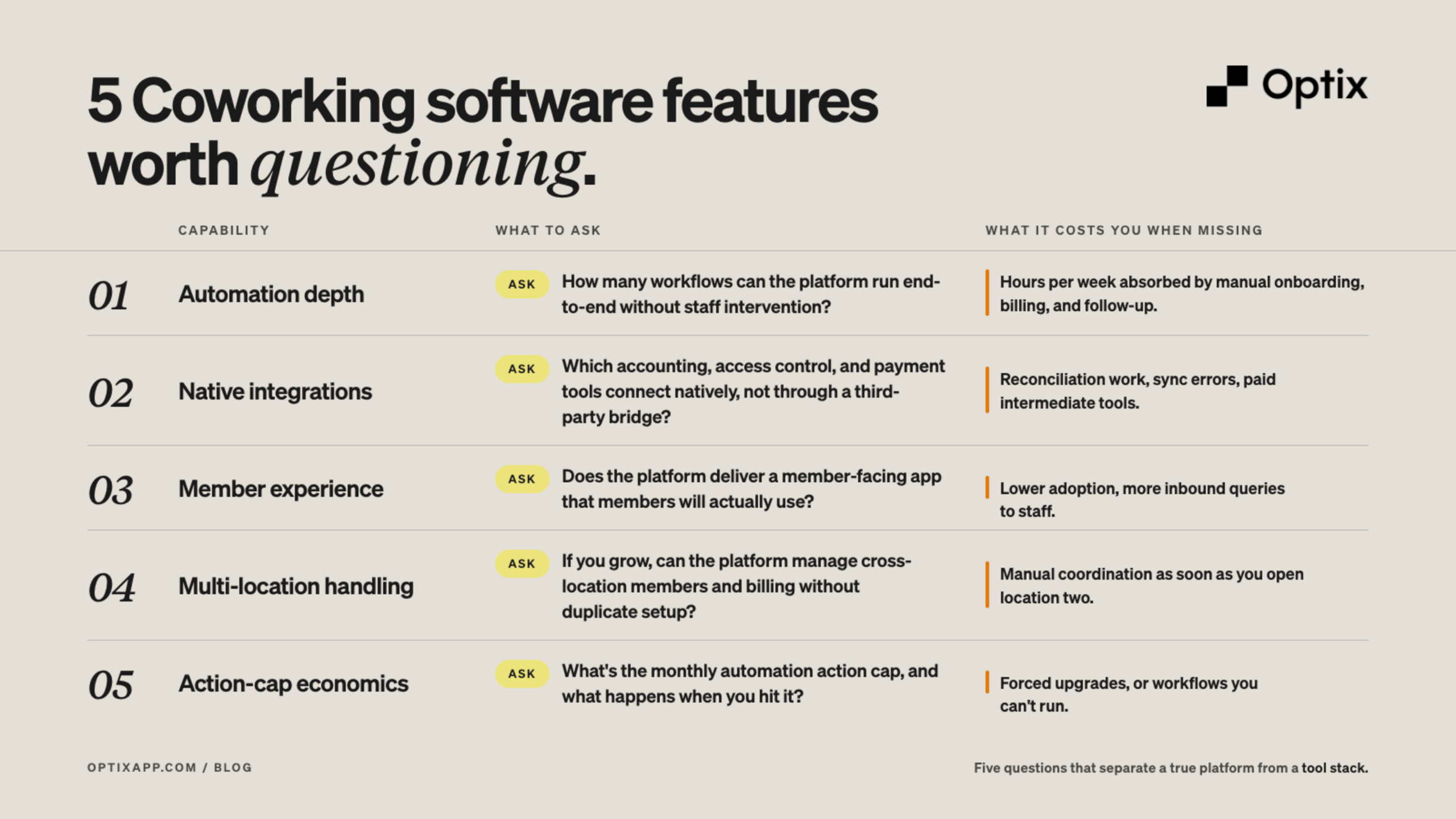
The right comparison isn’t licence fee against licence fee. It’s capability against operational hours saved. The framework below restates the questions operators most often raise on demos as a practical buyer checklist.
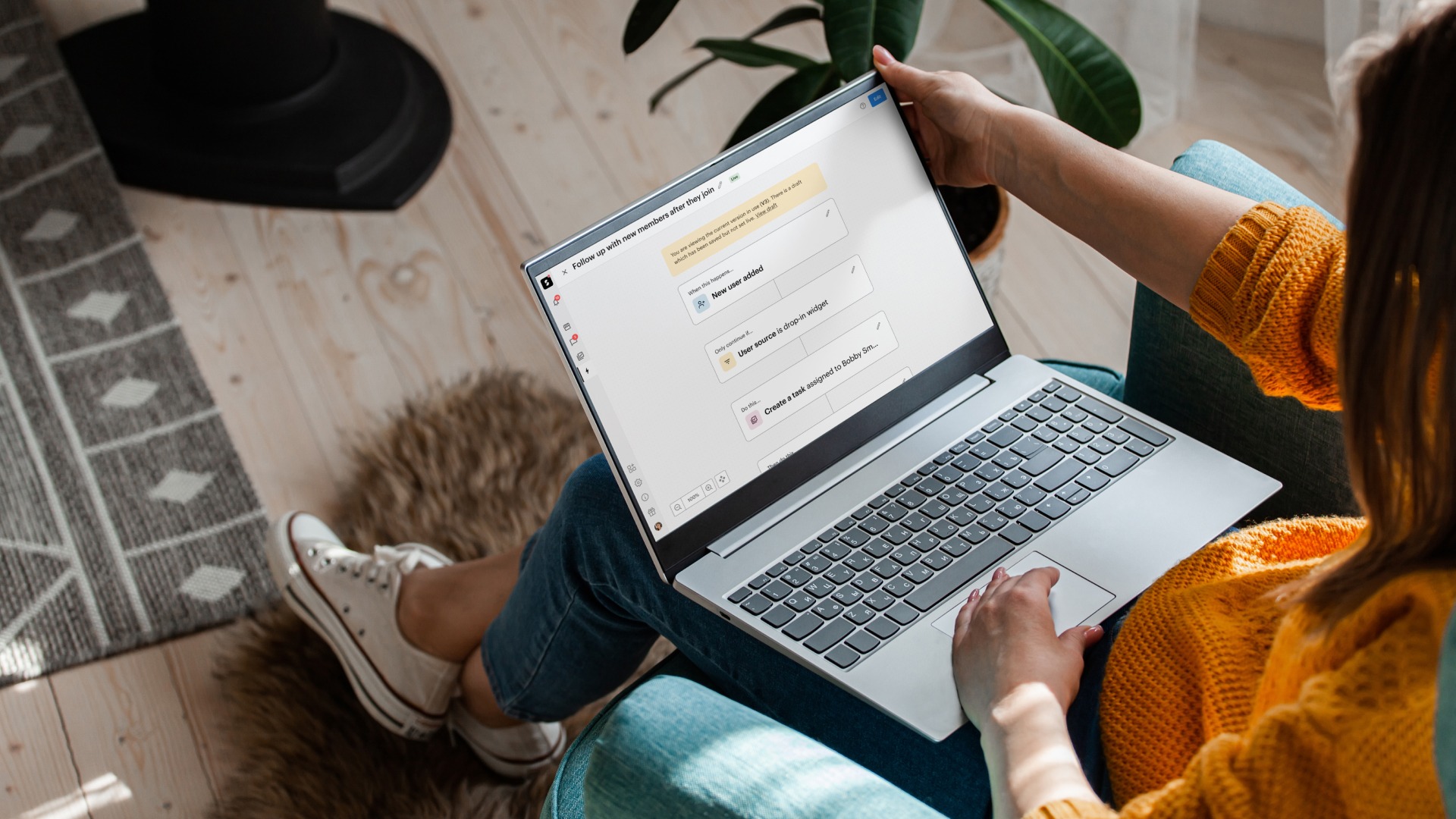
Booking automation, member onboarding sequences, and invoice follow-up are where coworking software earns its keep. A platform that can’t run those end-to-end is a platform that asks staff to do them. Optix is built around closing that gap.
How do operators recover the price difference after switching?
Operators who switch from cheaper platforms typically recover the price difference within weeks, paid back in time saved. The pattern shows up across customer outcomes regardless of space type or size.
At KoWorks, founder Adam Hyman runs three locations as the only person in the business, with around 30 automations handling work that previously required a team. “There’s only one person in this business, which is me now, and three locations operating efficiently. Good attendance, good revenue, good membership signups. A lot of it is attributed to Optix Automations.” KoWorks runs three locations with one person on a stack that recovered around 20 hours of admin time per week.
KWENCH, a 25,000 sq ft club in Victoria, BC, built more than 30 automations and ran 5,000+ automated actions inside the first 60 days after migrating. General Manager Caleb Van Der Kooi described the immediate operational shift: “We noticed an instant down-tick in members needing our assistance.”
Le Birdie operates 24/7 unmanned, serving more than 1,500 customers across 4,000+ bookings in six months without on-site staff. Co-founder Jessie Ouimette Caron put it simply: “I don’t understand in 2025 why someone would use a platform like this without Automations.”
The licence fee on each of these accounts is higher than entry-level alternatives. The total cost of ownership is lower, by a margin that grows with every month the automations keep running.
What questions should you ask before buying coworking software?

The right questions before signing are operational, not commercial. They surface where the platform draws the line between “automated” and “absorbed by staff.”
- What’s the largest workflow your platform handles end-to-end without manual intervention? Onboarding, tour follow-up, and overdue billing are the three to test by name.
- How many native integrations exist with accounting, access control, and payment tools, and what breaks when those tools update? Native integrations age better than third-party bridges.
- What’s the monthly automation action cap, and what does an upgrade decision look like when we hit it? This determines whether automation is a feature or a metered constraint.
- Can a member do their full membership journey in your app without ever calling a staff member? Booking, payment, access, and issue reporting are the four to verify.
- What’s a reasonable estimate of staff hours your platform saves per week, attributed to specific automations? Vague claims of “time savings” don’t survive a buying decision.
- Where does the platform fail today? A vendor who can’t answer this is a vendor who hasn’t been pressure-tested.
These are the questions the operator survey behind these numbers was designed to surface. The answers separate platforms that earn their licence fee from platforms that quietly transfer the cost to your team.
Key Takeaways:
- Licence fees are predictable, which is exactly what makes them misleading as the basis for comparing coworking software.
- Operational time is the dominant hidden cost: the work staff do to fill gaps the platform doesn’t close.
- 89% of coworking operators say operational efficiency would be automation’s biggest impact; 63% want more time for community work.
- Cheaper software typically saves on the invoice and costs more in salary, with the gap widening as the space grows.
- The right buying questions are operational: which workflows run end-to-end, what integrates natively, what happens at the action cap.
- Operators who switch to automation-first platforms recover the price difference within weeks through time saved.
Frequently asked questions
Coworking automation typically saves operators 10 to 20+ hours a week, depending on how many workflows are automated end-to-end. Independent operator surveys show 89% of coworking owners cite operational efficiency as automation’s biggest impact, with the largest gains coming from member onboarding, tour follow-up, and overdue billing.
Total cost of ownership for coworking software is the licence fee plus every operational hour staff spend on tasks the platform can’t automate, plus the cost of integration tools and workarounds. A 2026 industry analysis identified operational time as the dominant hidden cost, often exceeding the subscription itself over a year.
Automation determines how much of the platform is software and how much is staff. A platform without deep automation capacity transfers the work of running it to your team, which makes the licence fee the smaller line of a larger bill. Treating automation as a feature comparison alone underestimates the operational consequences.
Operators who switch to a platform with stronger automation typically recover the licence-fee difference within weeks through time saved. KWENCH, for example, built more than 30 automations and ran 5,000 automated actions inside the first 60 days post-migration, with measurable reductions in member-facing admin from week one.
Both, because they are related. Integrations determine which tools the platform can talk to natively. Automations determine what the platform does with that connection. A platform with strong integrations but weak automation still leaves staff to handle the orchestration. The two compound.