Blog

Coworking Business Model: Examples and Revenue Streams [2025]

The coworking space business model blends memberships, space rentals, and value-added services to generate revenue
By Kelly Karn
November 4, 2025
People working on a laptop in a coworking space to help coworking generate more revenue.

Key takeaways:

  • The coworking business model relies on selling access to space, amenities, and communities to cover the operating costs of the business
  • Coworking operators rely on many different revenue streams to make money including membership plans, room rentals, virtual mail, partnerships, and food and drink services
  • Think creatively about monetizing space by renting your building out for events after-hours, maximizing space utilization (ie. renting empty private offices for day-use), and charging for add-ons strategically


Updated: November 4, 2025

The foundation of the coworking business model is relatively simple: you sell space to others to cover your own costs.

But if you think that’s where things end, think again. 

Today we’re unpacking exactly how coworking spaces make money, and more importantly, how you can optimize the business model of your coworking space to ensure profitability long-term.

The knowledge in this article is based on the Optix team’s 10+ years of experience in the coworking industry working alongside hundreds of owners and operators to run successful, profitable coworking businesses.

Now, we’re sharing that knowledge with you.

What is a coworking space?

A coworking space is a shared workspace or office space used by knowledge workers including freelancers, remote employees, and entrepreneurs. It is typically made up of a variety of bookable spaces or resources including meeting rooms, conference rooms, private offices, and desks. Members can book one of these resources and pay for it on-demand (ie. $20 for a daily desk pass) or pay a membership fee for ongoing use (ie. $200 for unlimited desk rentals every month).

What are the types of coworking spaces?

The first coworking space opened in San Francisco in 2005 to meet the needs of remote workers and entrepreneurs. Since then, coworking has expanded to many other industries or niches including:

The expansion of coworking across a variety of different industries, needs, and niches shows the versatility of the business model, as well as the maturation of coworking as a concept.

Grindhaus is a coworking and flex recording studio
Grindhaus flexible recording studio and coworking space

What is the coworking space business model?

The coworking space business model involves individuals paying a small fee (membership plan) in exchange for access to workspace (desks, offices, meeting rooms), services (WiFi, virtual mail), and community (events, online platform). Operators use this money to cover the cost of renting and running the physical space.

Example: the coworking business model in action

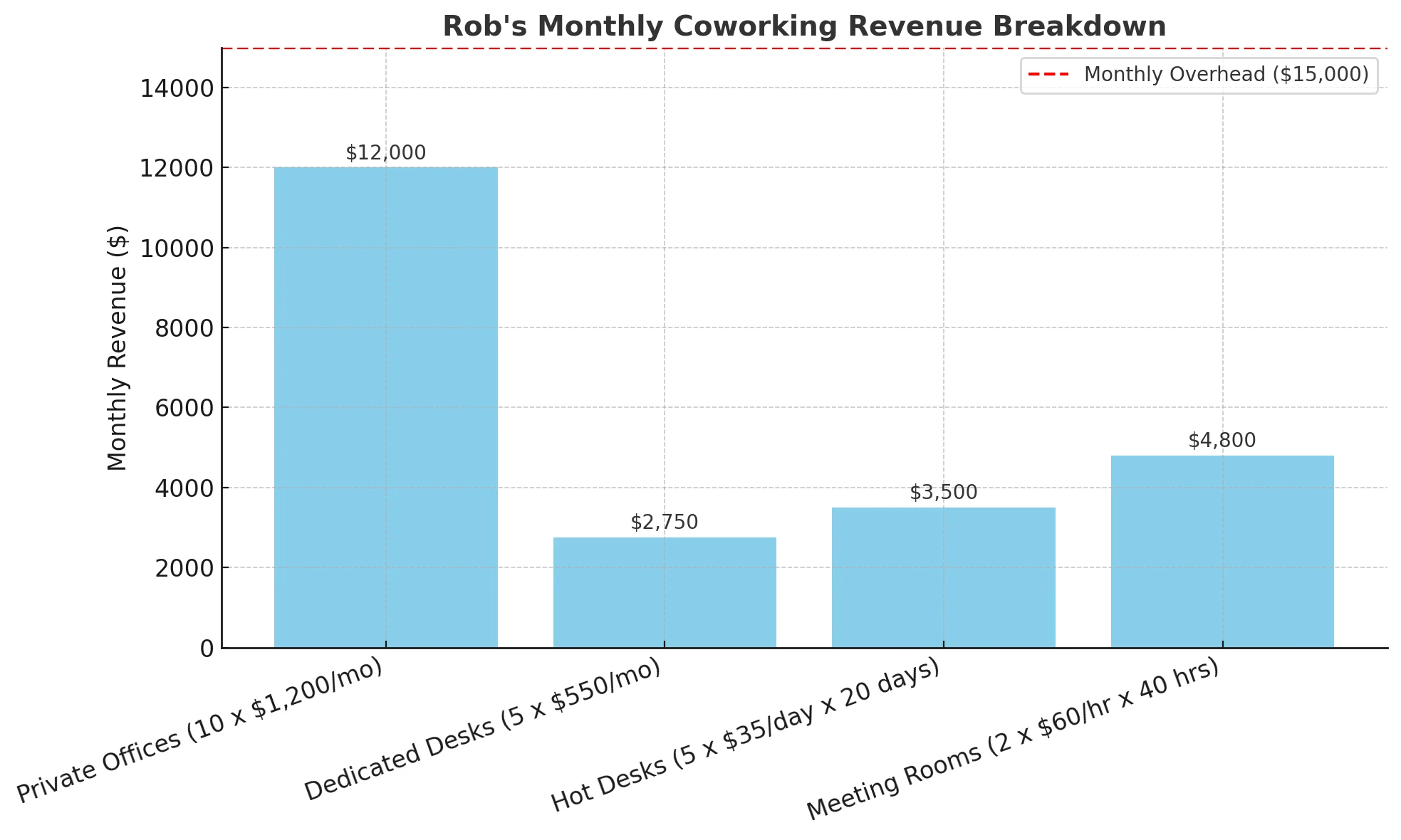
Rob leases a small office building in his neighborhood for $10,000/month. He has a few recurring payments and staff that puts his total overhead at $15,000/month. He converts the space into 10 private offices at $1,200/mo, five dedicated desks at $550/mo, five hot desks at $35/day, and 2 meeting rooms at $60/hr

In this example, Rob is able to cover the costs of his coworking business at 100% occupancy of his private offices and dedicated desks. Assuming 1-2 hot deskers a day and occasional meeting room bookings still doesn’t leave much room for profit.

So how else are operators able to generate revenue?

Chart showing an example of the coworking space business model in action
A breakdown of how coworking spaces generate revenue through different resources

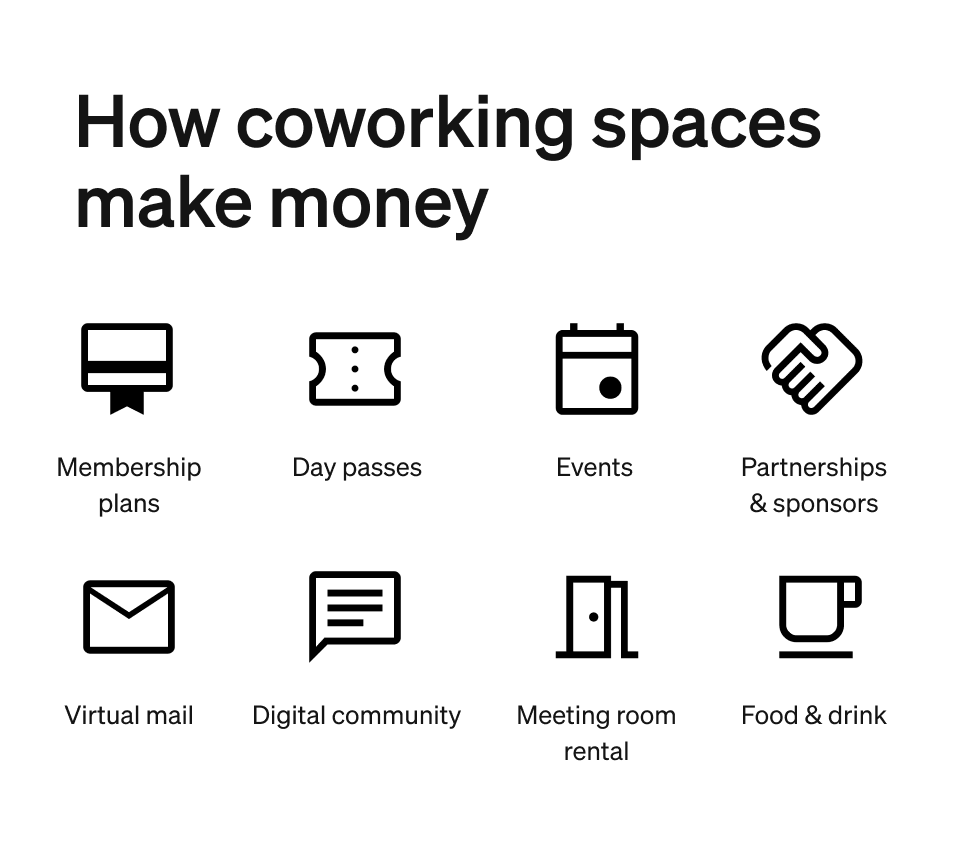
How do coworking spaces make money?

Coworking spaces primarily make money by selling access to space (private offices, meeting rooms, hot desks). However, most coworking operators prefer to have a diverse range of revenue streams (membership plans, room rentals, virtual mail, partnerships, food and drink services) for a healthy revenue stream.

Membership plans

A membership plan is any recurring subscription for coworking services.

Examples:

  • $1,200/mo private office plan with unlimited use
  • $550/mo dedicated desk plan with unlimited use Monday-Friday
  • $150/mo flex membership plan that includes access to a digital community and five hot desk days a month

What you need to know: Membership plans are the bread and butter of the coworking business model and what most coworking operators aim to acquire more of. Lock in recurring revenue via membership plans to help with financial forecasting and ensure predictable revenue streams month over month.

Growing a coworking space? You need Optix.


Woman in coworking space

Day passes

Day passes are one-time subscriptions for coworking services that typically grant access to use of a single resource (hot desk) for the day.

Examples:

  • $20/day hot desk use from 9 am to 5 pm
  • $100/day meeting room use from 9 am to 5 pm

What you need to know: Day passes generate more revenue per desk than other membership plans. New operators are often tempted to crowd their space with drop-in desks for this reason. The challenge is, drop-in day passes are unpredictable — and in the post-COVID era, they can be the hardest seats to fill.

Events

Coworking events are a community gathering (happy hours, workshops, fitness classes) before, during, or after work hours.  

Examples:

  • Thursday night happy hour
  • Waffle Wednesdays
  • Monthly open house

What you need to know: Events have exploded in popularity post-COVID. Consider if you will include event access in membership fees, charge for events, or a mix of both. Some of our clients make events free for members and charge non-members for access — not only does this generate revenue from non-members, it also can be used to generate leads and convert casual users to dedicated members.

Room and space rentals

Room and space rentals include the rental of a meeting or conference room on an hourly or daily basis, as well as rental of the entire space or part of the space after-hours. 

Examples:

  • $60/hour for meeting room rental
  • $500/hour for entire space rental (after hours)

What you need to know: After-hours rentals can be very lucrative. In a Coworking Resources webinar, consultant David Walker from coworkingconsulting.com mentioned that he had seen a lot of success with operators renting their space to the broader community after-hours. Coworking spaces are one of the few venues that are able to accommodate larger parties, so there’s an opportunity to serve this need well.

Partnerships and sponsorships

Partnerships and sponsorships involve creating relationships with other businesses and leveraging access to your community in exchange for financial compensation or exchanged value.

Examples:

  • A local cafe sponsors your next open house and provides complimentary food and beverages
  • You partner with a local running company to sponsor your monthly hiking meet-up

What you need to know: Sponsorships can be very lucrative when approached strategically. For example, Steve Krueger, Founder at ECOMsquare, developed partnerships with brands like American Express and Lululemon wherein they sponsored events or activities in exchange for access to his membership base of professionals in ecommerce.

Digital community access

Online communities give members access to a group of like-minded individuals to connect with via a robust messaging platform like that in Optix coworking software.

Examples:

  • $10/mo for full access to your digital community

What you need to know: Online community access can be a nice entry-level offering for hesitant coworking members. It’s a small enough cost that people will be willing to pay for it, and it can even serve as a way-in to a bigger ticket item in your community.

Virtual mailbox services

Virtual mail is a service where members pay a small fee to use the coworking space as their business address and access other virtual services (mail handling, call-answering).

Examples:

  • $30/mo for business address use
  • $50/mo for business address and mail handling
  • $80/mo for business address, mail handling, and call answering

What you need to know: Like events, virtual mailbox services are rapidly growing in popularity amongst coworking owners and operators because of their revenue generating potential. Coworking space operators with successful virtual mail programs can see a 30% increase in revenue.

Food, drinks, and cafe services

Premium food (cookies, chocolate bars, chips) and beverages (lattes, espresso) are available at an additional cost.

Examples:

  • $3 for a candy bar
  • $4 for a larre

What you need to know: While some operators offer candy bars in the kitchen at $3 each, other operators take this one step further and build out integrated cafe offerings. For example, Flockd in Australia offers a cafe on-site as an amenity to their members. Members love the one-stop shop, and their team is able to generate additional revenue from food and beverage purchases throughout the day.

How coworking spaces make money
Different revenue streams that help coworking spaces make money

Is coworking a good business model?

Yes, coworking is a good business model. There is opportunity for diverse revenue streams, it is straightforward and accessible, it addresses a growing need and it can be a long-term investment. The cons of the coworking business model include high operating costs, difficulty acquiring and retaining members, lots of market variability, and large capital requirements.

The pros of the coworking business model

  • Opportunity for diverse revenue streams: coworking spaces can generate revenue from various sources
  • Straightforward and accessible: the business model is straightforward, needing just space and furniture to get started
  • Addresses a growing need: coworking is growing in popularity, making it an attractive business venture for aspiring entrepreneurs  
  • Can be a long-term investment: for operators who buy their building, coworking can be a great long-term investment in the real estate market

The cons of the coworking business model

  • High operating costs: managing overhead costs, such as rent, utilities, and staffing, can be challenging, particularly in high-rent areas
  • Hard to acquire and retain members: maintaining a consistent member base is difficult, with high member turnover
  • Lots of market variability: success can be influenced by local economic conditions, real estate market trends, and demand, all of which fluctuates
  • Large start-up capital requirements: starting a space may require significant upfront investment in lease agreements, furnishings, technology, and amenities

Table Summary

Pros Cons
Opportunity for diverse revenue streams High operating costs
Straightforward and accessible Hard to acquire and retain members
Addresses a growing need Lots of market variability
Can be a long-term investment Large start-up capital requirements

How to price your coworking products

One of the best ways to set the cost of your coworking products is to work backwards from your total operating costs and desired profit. 

Going back to our earlier example, if it costs Rob $15,000/mo to run his coworking space and he wants to make at least $10,000/mo in profit to start, then he will have to price his coworking space so that it generates at least $25,000/mo.

This may look like: 

  • 5 hot desks x $35/day = $5,250
  • 5 dedicated desks x $550/mo = $2,750
  • 10 private offices x $1,200/mo = $12,000
  • 2 meeting rooms x 60/hr with an average use of 2 hr/day = $7,200

We always recommend experimenting with your pricing and iterating until you find the sweet spot — a cost that is high enough to generate profit, but still perceived as fair by the community. A big part of figuring out your ideal pricing is trying different things and seeing what works.

Free Coworking KPI Cheat Sheet

KPI one-pager for coworking space owners and operators

How do I optimize my coworking space business model?

From offering the right products to improving space utilization, here’s how to optimize your coworking space business model for revenue.

1. Avoid relying on membership revenue alone

While you can grow your revenue with membership plans alone, growth is always going to be limited by the amount of space you have available. Therefore, most operators choose to incorporate other offerings into their product mix.

Events and space rentals can be huge for growing your business revenue and the potential for growth is much higher than relying on selling more hot desks each day. You may also want to consider offering additional services or amenities including:

The more diverse revenue streams you have, the better.

2. Think creatively about monetizing space

Operators who think creatively and strategically about monetizing space are more likely to find long-term success. 

  • A few weeks ago while visiting a local coworking space, we learned that one operator uses a private office space as a hot desk option while they’re between tenants in order to maximize profits from a single resource
  • Another operator splits his private office between two members, with one using the space on Tuesdays and Thursdays, and the other on Mondays, Wednesdays, and Fridays. He then charges more for this custom arrangement than he normally would for a private office

3. Be intentional with how you charge for add-ons and services

When it comes to charging for add-ons and services, like gym facility access for example, there are two common structures that we see.

Membership plan bundle. Here, operators bundle some or all of your additional services with different tiers of membership. For example, Basic memberships get access to the space ($), Pro memberships get access to the space and select services ($$), and VIP memberships get access to the space and all services ($$$). The advantage here is that you can typically charge a higher base price across all memberships because the value-add service is included.

Add-ons only. Here, operators offer add-ons and price them individually, such as $5/mo for Adobe photoshop access, $80/hr for massages, and $10/mo for virtual community access on top of a hot desk plan. The advantage to this structure is you usually have the potential to generate more revenue. However, this revenue is not guaranteed. 

One thing to keep in mind — while it’s great to offer your members lots of options, you don’t want to offer so many add-ons that your pricing is confusing and members are unsure as to what the space is really offering. 

Striking a balance in your membership plans between included and add-on services and offering a mix of both can help you avoid this.

How can technology improve the business model of my coworking space?

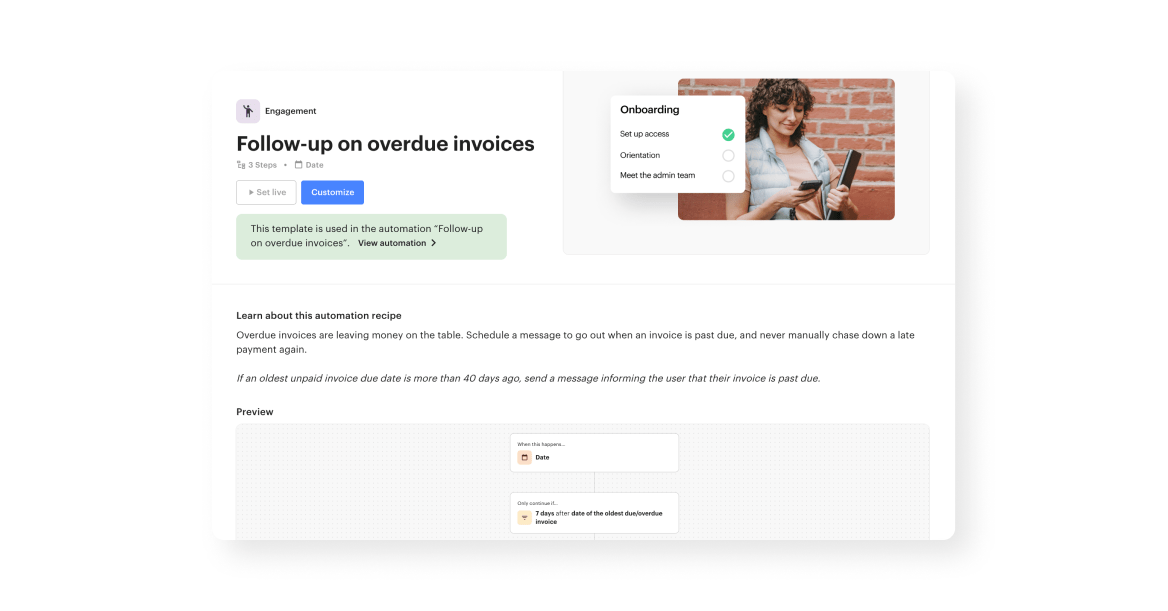
Coworking software like Optix can improve your business model through powerful automation capabilities. Automation is one of the best ways to grow your coworking business without growing your headcount. This make it easier to scale your coworking space over time.


Follow-up on overdue invoices automatically with Optix Automations

With automation-first coworking technology, you can:

  • Save up to 63% of your time: automation helps give you your time back so you can spend it on higher value work
  • Create a more engaged community: use automation to remember member milestones and facilitate online conversation
  • Grow your business: get more done with less resources so you can think more creatively about headcount

Optix is the only coworking software that can automate your business across the entire member journey, end-to-end. Learn more about it here.

Start your coworking business today

Coworking spaces are in a unique position to serve the growing need in the community for a third space. 

To succeed in this field, you need a smart business plan, happy members, and good solutions for people who work today. As work keeps changing, coworking spaces are leading the way, offering both a chance to make money and to be innovative in this growing industry.

New to coworking? Check out our collection of articles on starting a coworking business.

Author Avatar
Author: Kelly Karn

Marketing Manager

Kelly Karn is the Marketing Manager at Optix coworking software. She's been covering the latest and greatest in the world of coworking for 4 years and is one of the leading voices in coworking content having written over 300 articles. You can find her work on Coworking Insights, Coworking Resources, Allwork.space, DeskMag, GCUC, and (of course) the Optix blog.

Frequently asked questions

To boost occupancy during slower periods, coworking operators can offer short-term promos for private offices, partner with local event organizers, and push flexible memberships through email and community channels. Tracking lead sources and adjusting pricing dynamically helps fill space without eroding long-term value.

Member churn in coworking spaces often comes from poor communication or lack of community engagement. Regular check-ins, feedback loops, and value-add events help retention. Operators can use tools like Optix to automate renewals, flag at-risk members, and track satisfaction trends before they turn into cancellations.

Operators can grow revenue by adding high-margin services — like virtual offices, mail handling, storage, or event rentals. Upselling meeting room credits or implementing dynamic pricing can also lift average member value. Tracking utilization through your coworking management platform shows where capacity exists to monetize.

Technology reduces manual work — automating bookings, billing, and check-ins while tracking performance KPIs in real time. Platforms like Optix integrate these functions, helping coworking operators make data-driven decisions, reduce admin costs, and deliver a smoother experience to members.